(redirected from ATP)

[Home]Adenosine triphosphate

HomePage | Recent Changes | Preferences | Random Page

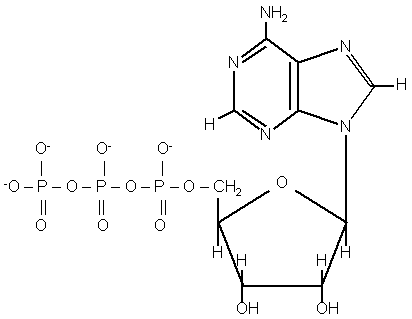
In biochemistry, adenosine triphosphate (commonly called ATP) is the "molecular currency" of intracellular energy transformations. It is a means of storing and transporting chemical energy within the cell, and a precursor for RNA formation. Chemically adenosine triphosphate consists of the adenosine? nucleotide (which is ribose? sugar and adenine? base) plus three other phosphate groups.

upload:ATP.png
(Image is in the public domain)

The hydrolysis? of the phosphate-phosphate bonds releases energy that can be used by a variety of enzymes, [motor proteins]?, and [transport proteins]? to carry out the work of the cell. This hydrolysis leads to free inorganic phosphate ion and [adenosine diphosphate]?, which can be broken down further to [adenosine monophosphate]?.

ATP can be produced by various cellular processes, most typically by the oxidation in mitochondria.

In living cells there are also other energetic nucleoside? triphosphates like [guanine triphosphate]?. Energy can be easily transfered between them and ATP in reactions like (catalyzed? by [nucleoside diphosphokinase]?):

ADP? + GTP? <-> ATP + GDP

See also: cyclic adenosine monophosphate, [adenosine monophosphate]?, [adenosine diphosphate]?


External link: http://gened.emc.maricopa.edu/bio/bio181/BIOBK/BioBookATP.html


HomePage | Recent Changes | Preferences | Random Page
This page is read-only | View other revisions
Last edited November 14, 2001 12:29 pm by Magnus Manske (diff)
Search: